
Michael Helenek
Cinematographer
No cuts for 12 minutes.
For Monster in a House, I was tasked with filming the entire movie, which involved a young girl running through a haunted home, in one steadicam shot. The film was a "oner" – Chris Dias, our director, did not want any cuts. You can watch a short segment of the film to the right.
Chris and I drafted storyboards that indicated which frames we wanted to hit for each scene. Once boards were roughed in, I created camera diagrams that detailed steadicam movement and actor blocking for the entire movie. See the video to the right for an example of one of these diagrams.
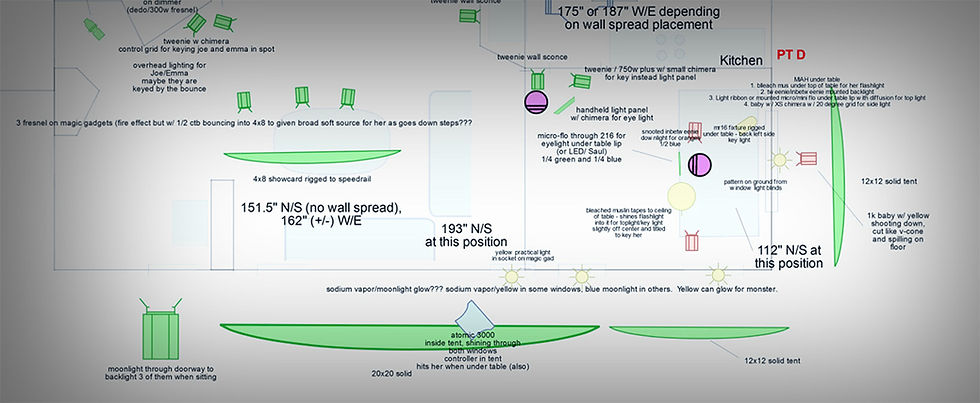
Since our steadicam was following the actress running throughout the house, lighting units needed to be rigged out of sight in the ceiling or positioned outside the windows. I created detailed lighting plots for both the upstairs and downstairs (see picture →) Our key grip and gaffer utilized these lighting plots during our rigging days.
The film performed incredibly well in festivals and was recognized by American Cinematographer Magazine. Several behind-the-scenes and festival photos are below.


No cuts for 12 minutes.
For Monster in a House, I was tasked with filming the entire movie, which involved a young girl running through a haunted home, in one steadicam shot. The film was a "oner" – Chris Dias, our director, did not want any cuts. You can watch a short segment of the film below.
Chris and I drafted storyboards that indicated which frames we wanted to hit for each scene. Once boards were roughed in, I created camera diagrams that detailed steadicam movement and actor blocking for the entire movie. See the video below for an example of one of these diagrams.
Since our steadicam was following the actress running throughout the house, lighting units needed to be rigged out of sight in the ceiling or positioned outside the windows. I created detailed lighting plots for both the upstairs and downstairs (see below) Our key grip and gaffer utilized these lighting plots during our rigging days.
The film performed incredibly well in festivals and was recognized by American Cinematographer Magazine. Several behind-the-scenes and festival photos are below.
LED volume planning.
We filmed Elder Scrolls Online in an LED volume for ease of changing out digital backgrounds. Every one of our presenters spoke in a distinct setting, which called for a different background plate. In front of the background plate, we had column set pieces to add visual interest.
In addition to finding interesting compositions and coordinating with our director to determine coverage, one of my tasks as DP was to have the lighting on the presenters either match or compliment the background scenes. During pre-production I created a spreadsheet for each background plate. For each scene I made lighting notations and detailed the lens choices for A & B cameras. This was complimented with a lighting plot for our gaffer and key grip.
On productions where there are only one or two filming days and page count is high, mapping out cinematography transitions is how I ensure we make our day and maintain high production value.
Below is a bts video that shows our production design, grip, electric, camera, and HMU crews at work.


LED volume planning.
We filmed Elder Scrolls Online in an LED volume for ease of changing out digital backgrounds. Every one of our presenters spoke in a distinct setting, which called for a different background plate. In front of the background plate, we had column set pieces to add visual interest.
In addition to finding interesting compositions and coordinating with our director to determine coverage, one of my tasks as DP was to have the lighting on the presenters either match or compliment the background scenes. During pre-production I created a spreadsheet for each background plate. For each scene I made lighting notations and detailed the lens choices for A & B cameras. This was complimented with a lighting plot for our gaffer and key grip.
On productions where there are only one or two filming days and page count is high, mapping out cinematography transitions is how I ensure we make our day and maintain high production value. Below is a bts video that shows our production design, grip, electric, camera, and HMU crews at work.
Three camera visuals.
Handstand was an instructional "masterclass-eque" video that centered around an interview with fitness expert Yuri Marmerstein. My goal was to make the interview look dramatic, but also make the lighting on on Yuri's face appear natural and motivated within the space.
Instead of directly backlighting Yuri, I decided to light the mid-ground gym equipment not only to create depth, design, and perspective, but also to create some seemingly "natural" light that I knew would subtly bleed onto the back of his figure and create separation.
Yuri's wardrobe and the location were monochrome. Given that, I wanted to introduce some color and subtly link Yuri's warm skin tones and the orange of his beard with the background. We placed a very subtle orange accent on the deep back wall and also warmed up the light coming out of the office window.
We had three cameras running simultaneously (profile, medium shot, and 3/4 mcu). This made lighting a bit more challenging, but as a result of our pre-production scouting and planning (see lighting/camera diagram → ) we were able to accomplish our goal.


Three camera visuals.
Handstand was an instructional "masterclass-eque" video that centered around an interview with fitness expert Yuri Marmerstein. My goal was to make the interview look dramatic, but also make the lighting on on Yuri's face appear natural and motivated within the space.
Instead of directly backlighting Yuri, I decided to light the mid-ground gym equipment not only to create depth, design, and perspective, but also to create some seemingly "natural" light that I knew would subtly bleed onto the back of his figure and create separation.
Yuri's wardrobe and the location were monochrome. Given that, I wanted to introduce some color and subtly link Yuri's warm skin tones and the orange of his beard with the background. We placed a very subtle orange accent on the deep back wall and also warmed up the light coming out of the office window.
We had three cameras running simultaneously (profile, medium shot, and 3/4 mcu). This made lighting a bit more challenging, but as a result of our pre-production scouting and planning (see lighting/camera diagram above ) we were able to accomplish our goal.
Scouting in the savanah.
For Rite of Passage we weren't creating sets or lighting them, but rather seeking out ideal locations in nature, planning the best times of day to film, and coordinatng logistics.
After selecting Upper Las Virgines Open Space Preserve as our filming location (NW Los Angeles), Michael Krehan (director) and I did an initial scout of the nature preserve. To the right, you'll see a marked up Google map that Michael created linking various scenes to regions in the mountainous park. After initial scouting, I returned on my own on multiple occasions to map the sun, determine the best time of day to film each scene, and to pre-frame shots. I knew crew & equipment logistics in this terrain would be very challenging which was even more reason to be extremely prepared. See crew photo photo to the right → and several film frames below.


Scouting in the savanah.
For Rite of Passage we weren't creating sets or lighting them, but rather seeking out ideal locations in nature, planning the best times of day to film, and coordinatng logistics.
After selecting Upper Las Virgines Open Space Preserve as our filming location (NW Los Angeles), Michael Krehan (director) and I did an initial scout of the nature preserve. We marked up Google map that Michael generated linking various scenes to regions in the mountainous park. After initial scouting, I returned on my own on multiple occasions to map the sun, determine the best time of day to film each scene, and to pre-frame shots. I knew crew & equipment logistics in this terrain would be very challenging which was even more reason to be extremely prepared. See crew photo photo and several film frames below.